
Locating Log Files
In the event of an issue, your Square 9 Support Technician may ask for a variety of logs to be sent over for analysis. Here are the types of logs they may ask for, what application they are associated with, and where to find them.
GlobalSearch Desktop Client Error Log
-
Purpose: General-purpose error log for faults in
ssinterface.exe, including login and REST issues. -
Found on: Server and client applications.
-
Location:
C:\Users\<USERNAME>\AppData\Local\Square_9_Softworks\GlobalSearch\ErrorLog.log
GlobalSearch Extensions Log
-
Log.txt location example:
C:\Users\JOE\AppData\Local\Square_9_Softworks\GlobalSearch_Extensions\log.txt
GlobalCapture Engine Log
-
Purpose: Transcription of actions taken by the GlobalCapture Engine.
-
Found on: Engine server only. One log exists per engine.
-
Location:
C:\GetSmart\CaptureServices\GlobalCapture_<ENGINE#>\captureLog.log -
Verbose logging: Before editing, copy
C:\GetSmart\CaptureServices\GlobalCapture_1\Square9.GlobalCapture.exe.config. -
Change
<add key="VerboseWorkflowLog" value="false"></add>fromfalsetotrue, then restart theGlobalCapture_1service. If you have more than one engine, restart each engine whose config file you modify. When finished, change the value back tofalse.
GlobalAction Log
-
Purpose: Transcription of actions taken by the GlobalAction Engine.
-
Found on: App Server only.
-
Location:
C:\GetSmart\Workflow.logfor versions prior to 2.2;C:\GetSmart\ActionServices\GlobalAction_<ENGINE#>\actionLog.logfor versions 2.2 and later. -
Verbose logging: Before editing, copy
C:\GetSmart\ActionServices\GlobalAction_1\Square9.GlobalAction.exe.config. -
Change
<add key="VerboseWorkflowLog" value="false"></add>fromfalsetotrue, then restart theGlobalAction_1service. If you have more than one engine, restart each engine whose config file you modify. When finished, change the value back tofalse.
Mongo Log
-
Purpose: Transactional log of activity in the Mongo database. The detail level depends on the configured logging level.
-
Found on: App Server only.
-
Location:
C:\GetSmart\Mongodb\logs\mongo.log
IIS Log
-
Purpose: Logs application data related to IIS, its application pools, and subprocesses.
-
Configuration: IIS log files can be configured for different detail levels and can be turned on or off in Programs & Features.
-
Location: The location is configured in the IIS Web Management Console. See Microsoft IIS log file documentation.
-
Default location:
C:\inetpub\logs
License Manager Log
-
Purpose: Logs errors for the
SSLicenseCleanservice. -
Found on: App Server only.
-
Example error: “The request failed with HTTP status 403: Forbidden.” This can be caused by an outdated
SSLicenseCleanconfiguration file when using SSL. -
Default location, version 5 and below:
C:\GetSmart\Square9LicenseManager.log -
Default location, version 6 and up:
C:\Program Files\Square 9 Softworks\License manager\Square9LicenseManager.log
GlobalForms Log
Enable legacy GlobalForms console logging only temporarily and only for troubleshooting. Modern GlobalForms log files are written automatically.
-
Modern GlobalForms: Logs are written to the
logsfolder in the install directory. By default, this isC:\GlobalForms\logs. -
Check first:
service.err.logfor service errors, including startup failures, configuration errors, and connection problems. -
Request logging:
request.logrecords each web request when request logging is enabled. -
Updates:
update-history.jsonrecords automatic update dates and versions. If an update is rolled back automatically,update-failed.txtwill also be present. -
Service status: Open Windows Services and confirm GlobalForms Forms Server is Running, or run
sc.exe query GlobalFormsin PowerShell. To restart it, runRestart-Service GlobalForms. -
Before contacting Support: Collect the GlobalForms version, the contents of the
logsfolder, a copy ofconfig\local.jsonwith passwords and secrets removed, and the steps to reproduce the issue. -
Browser troubleshooting: Use developer tools (F12). The Console tab shows script errors and blocked requests, and the Network tab shows failed requests and status codes.
-
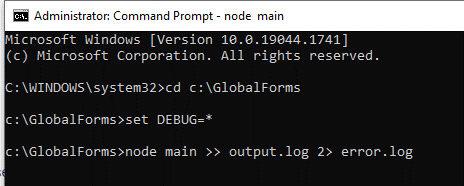
Legacy console logging: Older GlobalForms troubleshooting may still require temporary console logging. Stop the GlobalForms service, open a Command Prompt, navigate to the install directory, and run:
PowerShellset DEBUG=* & node mainTo capture console output to files for troubleshooting only, run:
PowerShellcd C:\GlobalForms set DEBUG=* node main >> output.log 2> error.log -
output.logcontains what appears when GlobalForms is launched in the console without debugging;error.logcontains the remaining debug output. -
Batch Portal
-
Purpose: Transcription of events taken by Batch Portal.
-
Enable logging: Update the Batch Portal config file and add:
HTML<add key="LogPath" value="C:\GetSmart\BatchPortal\batchPortal.log"></add> -
Restart: Restart the
ssBatchPortalservice in Windows Services.
Catalina Log
-
Purpose: Captures issues related to the Tomcat server running legacy GlobalForms.
-
Found on: GlobalForms Server only.
-
Notes: Logs may be separated by date.
-
Location:
C:\GlobalForms<yourVersion>\tomcat\logs\catalina.log
Frevvo Log
-
Purpose: Captures issues related to the legacy Frevvo LiveForms application.
-
Found on: GlobalForms Server only.
-
Notes: Logs may be separated by date.
-
Location:
C:\GlobalForms<yourVersion>\tomcat\logs\Frevvo.log
Some of these logs may be large and may need to be compressed to send over email.
Removing Log Files
In almost all cases, large log files can be deleted to free up space. It is recommended you keep the most recent logging, but old log files can take up unnecessary amounts of space and can be deleted without any repercussions relating to application function. A better, more non-destructive way to address this may be to zip up and compress these log files periodically, especially in the event the logs are required for future auditing.